Guide · 8 min read
Ordering food in Turkish: restaurant phrases, dishes and table manners
Food is the best part of any trip to Türkiye, and ordering it in Turkish is easier than you think. Waiters are used to tourists, but the moment you order in Turkish, the service changes. You get recommendations, extra bread, sometimes a free dessert, and certainly a big smile.
 Fatih Koçoğlu · Turkish teacher
In this guide you will learn the phrases for every step of a meal, from sitting down to paying, plus the dishes you will see on menus and the table manners that make you look like a local.
Types of places to eat
A lokanta or esnaf lokantası is a simple restaurant with ready-made home-style dishes in trays at the front. You point at what you want, which makes it perfect for beginners. A kebapçı serves kebabs, a pideci serves Turkish pide, and a meyhane is a tavern with meze and rakı. A büfe is a kiosk for quick sandwiches, and the çay bahçesi (tea garden) is where people sit for hours with tea.
Arriving and sitting down
When you come in, the staff will greet you with "Hoş geldiniz". Answer with a smile and tell them how many you are. If you want to book a table in a popular place, call and say "Masa ayırtmak istiyorum".
- Hoş geldiniz!hohsh gehl·dee·neezWelcome!Listen
- Hoş bulduk!hohsh bool·dookGlad to be here! (reply to "welcome")Listen
- Dört kişiyiz.durrt kee·shee·yeezWe are four people.Listen
- Masa ayırtmak istiyorum.mah·sah ah·yuhrt·mahk ees·tee·yoh·roomI'd like to book a table.Listen
▶ Video lessons
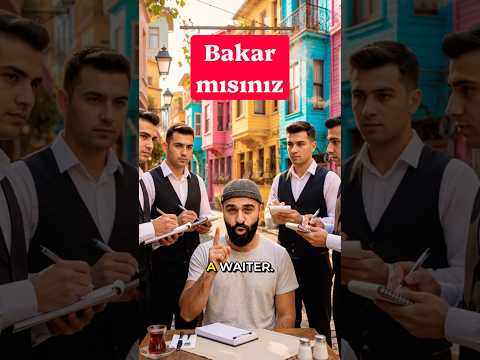


Calling the waiter and getting the menu
To get attention, say Bakar mısınız? (literally "would you look?"). It is polite and normal, and much better than waving wildly or saying "Garson!". Then ask for the menu, or simply ask what they recommend. In a lokanta, asking "Ne tavsiye edersiniz?" often gets you the best dish of the day.
- Bakar mısınız?bah·kahr muh·suh·nuhzExcuse me! (calling the waiter)Listen
- Menüyü alabilir miyim?meh·new·yew ah·lah·bee·leer mee·yeemCan I have the menu?Listen
- Ne tavsiye edersiniz?neh tahv·see·yeh eh·dehr·see·neezWhat do you recommend?Listen
Ordering
The easiest structure in Turkish is: the thing you want + lütfen. "Bir Adana kebap, lütfen", "İki çay, lütfen", "Bir ayran, lütfen". Remember that nouns stay singular after numbers: iki çay, not iki çaylar. A polite alternative is "... alabilir miyim?" (can I have ...?).
- Bir Adana kebap, lütfen.beer ah·dah·nah keh·bahp lewt·fehnOne Adana kebab, please.Listen
- Bir ayran, lütfen.beer ai·rahn lewt·fehnAn ayran (yogurt drink), please.Listen
- Su alabilir miyim?soo ah·lah·bee·leer mee·yeemCan I have some water?Listen
- Bir Türk kahvesi, lütfen.beer tewrk kahh·veh·see lewt·fehnA Turkish coffee, please.Listen
Ayran is a salty yogurt drink and the classic partner of kebab. Try it at least once. Turkish coffee is ordered with the sugar already decided: sade (no sugar), az şekerli (a little), orta (medium) or şekerli (sweet).
- Sade olsun.sah·deh ohl·soonWithout sugar, please.Listen
- Orta şekerli olsun.ohr·tah sheh·kehr·lee ohl·soonWith medium sugar, please.Listen
Special requests: spice, meat and allergies
Turkish food is not always spicy, but in the southeast (Adana, Urfa, Gaziantep) it can be. If you do not like heat, say "Acı olmasın". Vegetarians should know that many vegetable dishes are cooked with meat stock or minced meat, so ask directly. Zeytinyağlı dishes, vegetables cooked in olive oil and served cold, are usually meat-free.
- Acı olmasın.ah·juh ohl·mah·suhnNot spicy, please.Listen
- Çok acı!chohk ah·juhIt's very spicy!Listen
- Vejetaryen yemeğiniz var mı?veh·zheh·tahr·yehn yeh·meh·yee·neez vahr muhDo you have vegetarian food?Listen
- İçinde et var mı?ee·cheen·deh eht vahr muhDoes it have meat in it?Listen
- Alerjim var.ah·lehr·zheem vahrI have an allergy.Listen
Dishes you will see on Turkish menus
Çorba is soup; mercimek çorbası (red lentil soup) is a safe and delicious start to any meal. Meze are small starters such as haydari (thick yogurt with herbs), ezme (spicy tomato salad) and humus. Kebabs come in many styles: Adana is spicy minced meat on a skewer, Urfa is the mild version, İskender is döner on bread with tomato sauce and butter, and şiş is chunks of meat on a skewer.
Pide is a boat-shaped flatbread with toppings, and lahmacun is a thin, crispy flatbread with minced meat that you roll up with parsley and lemon. Mantı is tiny Turkish dumplings with yogurt and garlic. For breakfast, try menemen (eggs with tomato and peppers) and a full serpme kahvaltı, a spread of cheeses, olives, honey, jam and fresh bread.
For dessert there is baklava, künefe (warm cheese pastry in syrup), sütlaç (rice pudding) and kazandibi. Ask "Tatlı olarak ne var?" and let the waiter guide you.
- Tatlı olarak ne var?taht·luh oh·lah·rahk neh vahrWhat do you have for dessert?Listen
- Çok lezzetli!chohk lehz·zeht·leeIt's delicious!Listen
- Doydum.doy·doomI'm full.Listen
During the meal
Bread is unlimited and free in most restaurants; just ask for more ("Biraz daha ekmek alabilir miyim?"). Water may come in a sealed bottle and will be on the bill, so if you only want tap water, it is better to ask for a bottle anyway, as tap water is rarely drunk in restaurants. If you liked the food, tell the waiter "Çok lezzetli!"; he will pass it to the kitchen.
Paying the bill
When you are finished, call the waiter and say "Hesap lütfen". You can also make a writing gesture in the air. Ask if you can pay by card; most places accept it, but some small lokantas only take cash. A service charge (servis ücreti) is sometimes included. If not, a tip of around 5 to 10 percent is appreciated.
- Hesap lütfen.heh·sahp lewt·fehnThe bill, please.Listen
- Kartla ödeyebilir miyim?kahrt·lah ur·deh·yeh·bee·leer mee·yeemCan I pay by card?Listen
- Servis ücreti dahil mi?sehr·vees ewj·reh·tee dah·heel meeIs the service charge included?Listen
- Paket yapar mısınız?pah·keht yah·pahr muh·suh·nuhzCan you pack it to take away?Listen
Table manners and the bill fight
If you eat with Turkish friends, you will probably witness the famous fight over the bill. Everyone wants to pay, and the host usually wins. If someone says "Ayıp ettin, bu benden!" (don't be silly, this one's on me), let them pay and offer to pay next time. Trying to split the bill exactly can feel cold in a family setting.
- Ayıp ettin, bu benden!ah·yuhp eht·teen boo behn·dehnDon't be silly, this one's on me!Listen
- Bu benden!boo behn·dehnThis one's on me!Listen
Other manners: wait for the eldest to start eating, say Afiyet olsun to others at the table, and never leave a home meal without saying Ellerinize sağlık to the cook. In homes, refusing a second portion once is polite; you will be offered again, and again.
- Afiyet olsun!ah·fee·yeht ohl·soonEnjoy your meal!Listen
- Ellerine sağlık!ehl·leh·ree·neh sah·luhkHealth to your hands! (thanks for the food)Listen
- Biraz daha al!bee·rahz dah·hah ahlHave a little more!Listen
- Ellerinize sağlık, çok lezzetliydi.ehl·leh·ree·nee·zeh sah·luhk chohk lehz·zeht·lee·deeThank you, it was delicious.Listen
Your mini restaurant script
Here is a complete mini conversation you can practise. Waiter: "Hoş geldiniz, kaç kişisiniz?" You: "İki kişiyiz." Waiter: "Buyurun, şöyle geçin." You, after a moment: "Bakar mısınız? Menüyü alabilir miyim?" Then: "Bir mercimek çorbası, bir Adana kebap ve bir ayran, lütfen. Acı olmasın." At the end: "Çok lezzetliydi, teşekkürler. Hesap lütfen."
Say it out loud a few times. When you use it in a real restaurant in Türkiye, you will be surprised how smoothly it goes. And if you want all food and restaurant phrases offline, with menus and dish names, the travel phrasebook below is made for exactly that. Afiyet olsun!
More guides
- 30 Turkish phrases to learn before visiting Türkiye
- Turkish for taxis and airports: phrases that save you money and stress
- Turkish slang Istanbul locals really use (with examples)
- Turkish etiquette: the unwritten social rules of Türkiye
- Turkish words from Turkish dizi: learn with your favourite series
- Turkish numbers and bargaining at the bazaar
- Turkish greetings by time of day: from Günaydın to İyi geceler